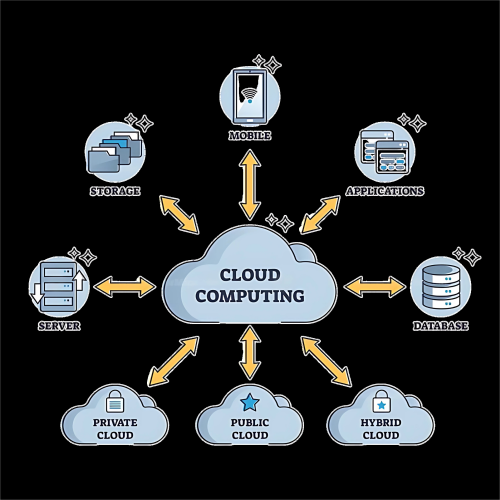
Cloud can be divided into two different layers, namely, front-end and back-end. The layer with which users interact is called the front-end layer. This layer enables a user to access the data that has been stored in the cloud through cloud computing software. Instead of storing files on a storage device or hard drive, a user can save them on the cloud, making it possible to access the files from anywhere, as long as they have access to the web. The services hosted on the cloud can be broadly divided into infrastructure-as-a-service (IaaS), platform-as-a-service (PaaS), and software-as-a-service (SaaS). Based on the deployment model, cloud can also be classified as public, private, and hybrid cloud.



The layer made up of software and hardware, i.e., the computers, servers, central servers, and databases, is the back-end layer. This layer is the primary component of the cloud and is entirely responsible for storing information securely. To ensure seamless connectivity between devices linked via cloud computing, the central servers use software called middleware, which acts as a bridge between the database and applications.
Cloud computing provides on-demand access to computing resources, such as storage and infrastructure, over the internet. This service model eliminates the need for individuals and businesses to manage physical resources, allowing them to pay only for what they use. There are four main types of cloud computing: private clouds, public clouds, hybrid clouds, and multiclouds. Additionally, cloud computing services are categorized into three main types: Infrastructure-as-a-Service (IaaS), Platform-as-a-Service (PaaS), and Software-as-a-Service (SaaS).